As the aerospace, automotive, drone, and electronics industries continue to pursue lightweight structures, integrated designs, and greater precision, aluminum alloy 3D printing has gradually become one of the popular technologies in the field of advanced manufacturing.
It is not simply a matter of replacing the plastic filament in a conventional 3D printer with metal. Instead, specialized metal additive manufacturing equipment builds components layer by layer by melting, depositing, or bonding aluminum alloy feedstock. The process can produce parts with complex geometries and internal features.
Understanding this technology also helps clarify how it differs from—and complements—traditional aluminum extrusion.
Conventional aluminum profiles are generally made from aluminum alloy billets. After the billets are heated, they are forced under pressure through a die opening to produce long profiles with a specified cross-sectional shape. Depending on the application, subsequent operations may include stretching and straightening, cutting to length, heat treatment, anodizing, or powder coating.
For products such as windows and doors, curtain walls, industrial frames, heat-sink bases, and equipment guide rails, extruded aluminum profiles offer several clear advantages:
These advantages have made extruded aluminum profiles widely used in construction, general machinery, consumer products, and architectural applications. For standardized linear profiles, tubes, and conventional structural components, extrusion remains one of the most cost-effective and efficient manufacturing options.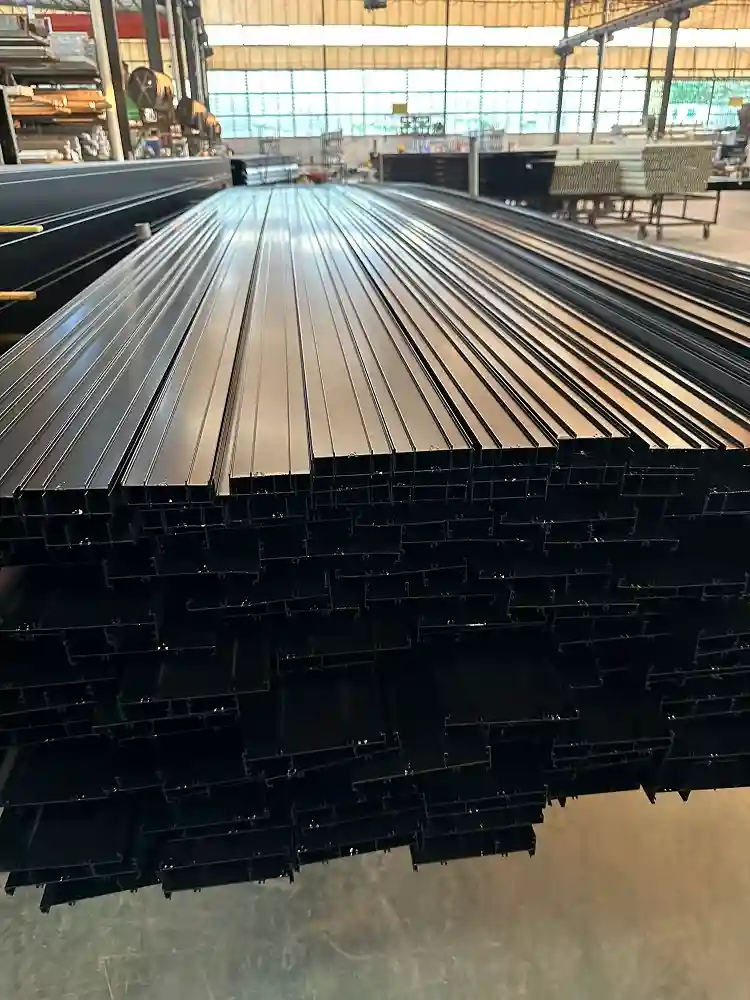
Traditional extrusion produces profiles with a largely constant cross-section along their length. It is therefore difficult to manufacture complex variable-section geometries, intricate internal cavities, lattice structures.
Traditional profile production relies on dedicated extrusion dies. Developing and manufacturing precision dies can be expensive and time-consuming. For small batches of customized precision components, tooling costs may be disproportionate to the value of the parts, making the process less economical.
When extruding very thin-walled sections, uneven metal flow can cause waviness, warping, or twisting. The thinner the walls, the more difficult it can be to maintain dimensional consistency. This makes it challenging to produce certain ultra-thin, highly precise components required for drones and electronic devices.
Many complex aluminum assemblies must be constructed by joining multiple standard profiles. Assembly gaps and welds can affect overall strength and fatigue performance, and may make it more difficult to meet the reliability requirements of advanced equipment.
Faced with the limitations of traditional processes, aluminum alloy 3D printing breaks the inherent constraints that "the more complex the structure, the higher the cost and the lower the feasibility," fully releasing the potential of aluminum alloy materials and becoming an important process supplement and innovative means for aluminum alloy processing in high-end precision fields.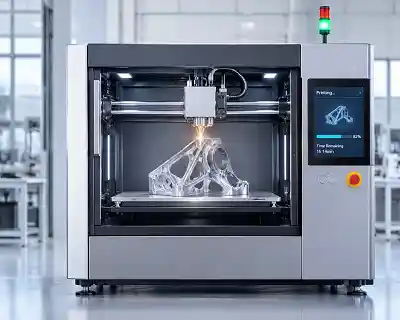
Aluminum alloy 3D printing is a form of metal additive manufacturing. It typically starts with a computer-aided design (CAD) model, which is digitally sliced into numerous thin layers. The machine then follows programmed toolpaths to add and bond aluminum alloy material layer by layer until the component is formed.
The process can be compared with other manufacturing methods: conventional machining removes material from a solid workpiece, while extrusion forces material through a die to create a continuous profile. Additive manufacturing, by contrast, builds material only where the digital design requires it, accumulating the part layer by layer.
Plastic 3D printing and metal 3D printing both use digital models and a layer-by-layer approach, but their feedstocks, equipment, and processing requirements differ.
The machine spreads a thin layer of metal powder across the build platform. A laser selectively melts the powder according to the cross-section of the part. The platform then lowers, a new powder layer is spread, and the cycle repeats until the component is complete.
LPBF is suitable for complex geometries requiring high dimensional accuracy and good surface quality. It is an important process for precision aluminum alloy components such as heat exchangers, lightweight brackets, and lattice or cellular structures.
In directed energy deposition, metal powder or wire is fed through a nozzle while a laser or another energy source melts the material and deposits it at a specified location.
DED is suitable for localized repairs, adding features to existing components, and producing or building up some larger parts. However, finer details and surface finish often require subsequent machining or other post-processing.
WAAM uses metal wire as feedstock. An electric arc melts the wire, and the molten material is deposited in successive layers. Its relatively high deposition rate makes it suitable for manufacturing large metal components efficiently, including certain large aluminum alloy structures.
However, electric arcs are directional and difficult to focus precisely like lasers, resulting in a less refined cladding trajectory and a very rough surface formed by stacking layers.Therefore, this technology needs to be combined with subsequent machining processes.
Aluminum alloy 3D printing can produce complex internal cavities, non-standard flow channels, lattice structures, cellular features, and integrated thin-wall designs that are difficult to form directly using conventional processes. Examples include lightweight aerospace brackets and thermal-management components.
Using a digital model and topology-optimization algorithms, designers can determine how material should be distributed within a component. Material is retained in load-bearing areas and removed from regions that contribute less to structural performance. This can create intricate, biomimetic or lattice-like structures while meeting defined strength and stiffness requirements and reducing weight.
Multiple independent parts can be combined into a single printed part, thereby reducing assembly steps and lowering the risk of dimensional errors caused by assembly.r. This supports lightweighting and functional integration in aerospace and automotive applications.
In the early stages, 3D printing of aluminum alloys primarily utilized eutectic alloys such as AlSi10Mg, which were mostly used for non-load-bearing prototypes. Today, specialized powders for wrought aluminum alloys—such as 6061 aluminum—along with optimized SLM (Selective Laser Melting) process parameters, have reached maturity. Printed components can achieve a density of over 99.9% and mechanical properties comparable to those of forged parts, enabling them to be used as functional structural components in end-use applications.
Because dedicated extrusion dies are not required for each complex geometry, design changes can often be implemented by updating the digital model. This makes additive manufacturing particularly attractive for prototype validation, customized components, spare parts, and product development.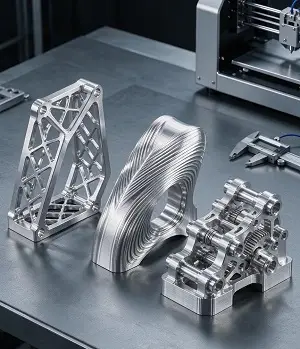
Despite its many advantages, aluminum alloy 3D printing faces the following challenges:
The most commonly used material is the AlSi10Mg cast aluminum alloy, which offers stable forming characteristics but possesses limited strength and ductility. High-strength aluminum alloys—such as those in the 2000 and 7000 series—are more prone to hot cracking.
Aluminum’s high laser reflectivity and rapid thermal conductivity lead to significant temperature fluctuations within the melt pool, often resulting in porosity, balling, and incomplete fusion.
A dense oxide film readily forms on the surface of aluminum powder, which reduces powder flowability, leading to uneven powder spreading and weakened interlayer bonding.
Rapid heating and cooling cycles generate enormous internal stress, which may cause parts to deform, warp, or even crack; therefore, the range of process parameters that can achieve ideal forming results is very narrow.
As-printed parts typically exhibit layer lines, surface roughness, and remnants of support structures. Precision mating surfaces often require additional grinding, polishing, or machining.
The layer-by-layer forming process is relatively slow, and the size of large, monolithic parts is limited by the dimensions of the machine’s build chamber. Furthermore, the cost advantage is minimal for large-scale components, simple geometries, or high-volume production.
Industries such as aerospace and automotive—as well as applications involving safety-critical components—require rigorous validation of fatigue performance, internal defect levels, and batch-to-batch consistency. Consequently, moving directly to mass production for critical load-bearing parts carries significant risk.
Therefore, the most suitable applications for aluminum alloy 3D printing currently include: internal flow channels, topology-optimized structures, conformal cooling molds, and small-batch, lightweight components.
For standard brackets, simple enclosures, and high-volume products, traditional casting or CNC machining are generally more cost-effective.
Future advances are likely to focus on developing aluminum alloys tailored for additive manufacturing, controlling cracks and porosity, improving in-process monitoring, optimizing heat treatment, and automating post-processing.
As material databases, simulation software, and inspection systems continue to improve, aluminum alloy 3D printing is expected to find broader applications in lightweight aerospace structures, automotive development and customized components, electronics, robotics, and energy equipment.
This does not mean that aluminum extrusion will be replaced. For long components with constant cross-sections and high production volumes, extrusion continues to offer major efficiency and cost advantages. Additive manufacturing has greater potential for complex three-dimensional geometries, internal channels, customized components, and part consolidation. In practice, hybrid manufacturing strategies—combining extruded profiles, machining, and 3D-printed components—can allow each process to be used where it performs best.
Traditional aluminum extrusion remains a cornerstone of standardized aluminum manufacturing, offering significant advantages in high-volume production, cost efficiency, and product consistency.
As an innovative precision-manufacturing technology, aluminum alloy 3D printing helps address some of the structural and process limitations encountered when producing advanced components through conventional extrusion alone. It creates new possibilities for complex designs, lightweight structures, and rapid product iteration. Rather than replacing extrusion, it expands the manufacturing options available to engineers and manufacturers.
Fortune Aluminum – As a professional manufacturer of extruded aluminum profiles, we do not have aluminum alloy 3D printing technology, but we can provide you with high-quality, stable-volume, and diverse extruded aluminum profiles for doors and windows.