Aluminium profiles for windows and doors, is a kind of building material for the decoration of window and door frames made of aluminium alloy as raw material. Its advantages are good wind pressure resistance, non-combustible, and it is a recognised flame retardant material.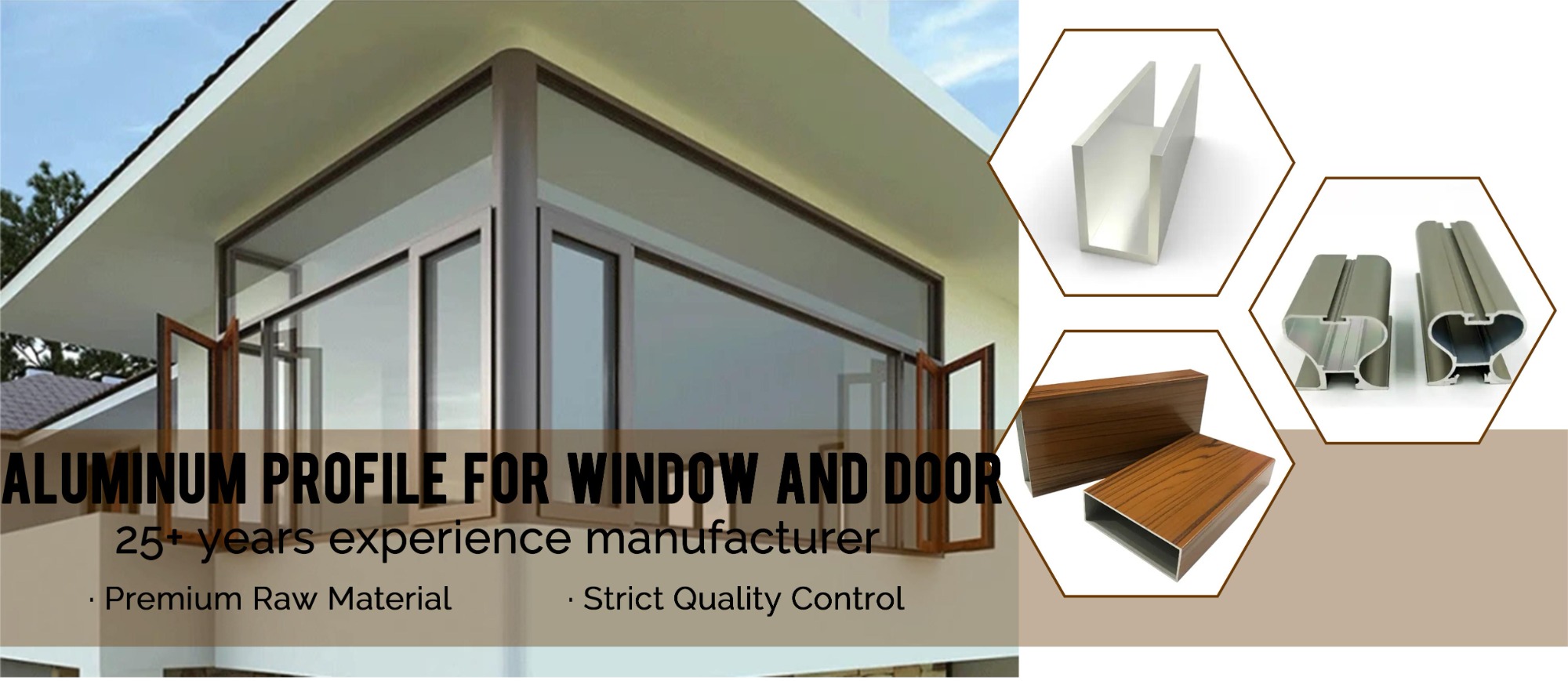
Ⅰ Product Description:
Frame material
Door and window materials, the material connected with the wall. Its main feature is that the surface where it meets the wall is mostly flat, fixed on the wall and cannot be moved.
Sector material
The material that can be opened in doors and windows. It is characterised by its ability to move.
Centre Trim
A material that divides the rectangle formed by the frame material into several small rectangles.
Real tappet: Fixed to the frame material;
False centre tappet: Fixed to the sash.
Crimp
Interior side, profile used to fix the glass.
Round crimp: suitable for 45 degree splices
Square crimp: suitable for 90 degree splices
Performance
1. Good heat preservation
K value - heat transfer coefficient
Ordinary aluminium alloy K=207 W/(m2k)
Broken bridge aluminium alloy K=2~4 W/(m2k)
2. Good sound insulation
Elaborate structural design, tight seams. Tested
3. Good air tightness
4. Good water tightness
5. Wind pressure resistance
Both sides of the decorative surface are aluminium alloy, good wind pressure resistance, doors and windows can be finished up to level 7.
6. Fire resistance
Aluminium alloy is metal material, not burning. The nylon 66 in the middle is added with flame retardant, which is non-combustible. It is a recognised flame retardant material.
7. Anti-theft
Broken-bridge aluminium alloy doors and windows, equipped with excellent hardware, so that thieves can do nothing.
Ⅱ Classification Of Aluminium Profiles For Doors And Windows
According to the opening mode
a. Inner opening
1. Inner casement
2. Internal opening and inverting
b. Outside opening
1. Outside opening
2. Outward turning
c. Push-pull
d. Folding
e. Lifting
According to the way of heat insulation
1. Non thermal insulation
2. Through the strip heat insulation
3. Glue injection heat insulation
Ⅲ Frame, Fan Material Distinction
Frame: edge sealing, upper solid, upper slide, lower slide, solid upper slide, solid lower slide.
Fan: upper, lower, high and lower, hook enterprise, light enterprise
