1.In industrial production, in order to distinguish the composition of aluminum alloy, the international use of 4-digit sign to mark.
Aluminum alloy grade number naming, four character system grade number of the first, third, fourth for the Arabic numerals, the second for the English capital letters (C, I, L, N, O, P, Q, Z letters except). The first digit of the number indicates the group of aluminum and aluminum alloy.
For example:
Industrial pure aluminum (1xxx series) Al-Cu alloy (2xxx series)
Al-Mn alloy (3xxx series) Al-Si alloy (4xxx series)
Al-Mg alloy (5xxx series) Al-Mg-Si alloy (6xxx series)
Al-Zn-Mg alloy (7xxx series) Al-other elements (8xxx series)
Alternate Alloy Groups (9xxx series)
6063 alloy is a typical representative of Al-Mg-Si alloy, which has particularly good extrudability and weldability, and is the preferred material for building door and window profiles. 6063 alloy composition is based on: silicon Si: 0.20-0.6%, magnesium Mg: 0.45-0.9%, plus trace iron, maganese, zinc, etc., and the final residual amount is aluminum. The series of alloy features: good extrudability easy to extrude, medium strength, the key is a good oxidation performance, to the aluminum door and window profiles a good decorative surface.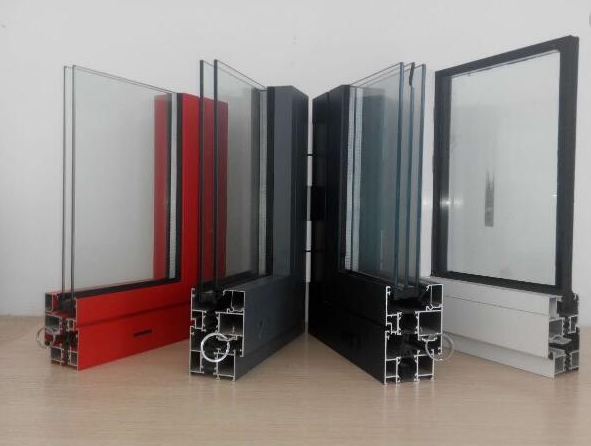
2. State code and representation:
According to GB/T16475-1996 standard, the base state code is expressed by one English capital letter. The subdivision state code is expressed by one, two or more Arabic numerals following the base state code.
Basic Properties and Main Application Areas of Aluminum
|
Code |
Name |
Description |
|
F |
free processing state |
applicable in the molding process, for work hardening and heat treatment conditions without special requirements of the product, the state of the mechanical properties of the product is not specified |
|
O |
annealed condition |
suitable for processed products that have been fully annealed to obtain the smallest strength |
|
H |
work-hardened condition |
applicable to products whose strength is improved by work-hardening, the products may or may not be subjected to additional heat treatment after work-hardening to reduce the strength, H code must be followed by two or three Arabic numerals |
|
T |
heat treatment state (different from F, O, H status) |
apply to heat treatment, after (or not) work hardening to acheive a stable state of the product; T code must be followed by one or more for the Arabic numerals |
Common T5 indicates: cooling by high temperature molding process, and then artificial aging state
According to the heat treatment state processed under different processes, generally will be divided into T1-T6 several. Common T5 is indicated: T5: solid solution treatment + incomplete artificial aging (low temperature + short time); after solid solution treatment of the alloy, its strength is lower, better plasticity. The purpose of solid solution treatment is aimed at obtaining a supersaturated solid solution to prepare the organization for aging.
Aging: In layman's terms, it is the method of quenching heat-treatable reinforced aluminum alloys and then leaving them at room temperature or higher to improve their properties. It is generally divided into natural aging and artificial aging; aging treatment is an important means to improve the mechanical properties and physical and chemical properties of aluminum alloys.
Natural aging: the casting is placed in the open field for more than half a year, so that it slowly deforms, so that the residual stress is eliminated or reduced;
Artificial aging: the casting is heated to 550-650℃ for stress relief annealing, which saves more time than natural aging, and the residual stress is removed more thoroughly.
