In the current market, many merchants of inexpensive, damaged aluminum windows fail to provide customers with accurate information regarding the specific configuration of the window. Instead, they often mention the use of glass from Xinyi/South Glass/Taiwan Glass, without mentioning the glass of secondary deep processing manufacturers. This practice may lead to confusion among customers.
First and foremost, Xinyi, SGS, TSG, and other prominent glass raw material manufacturers are well-known entities in the industry. In comparison to glass raw materials produced by smaller manufacturers, those produced by larger manufacturers are of superior transparency and flatness. Poor-quality glass raw materials will turn green. The glass used on doors and windows undergoes secondary deep processing by glass processing plants, which purchase glass raw materials from glass raw material manufacturers and carry out secondary deep processing in their own production workshops to produce insulating glass, laminated glass, vacuum glass, and so on.
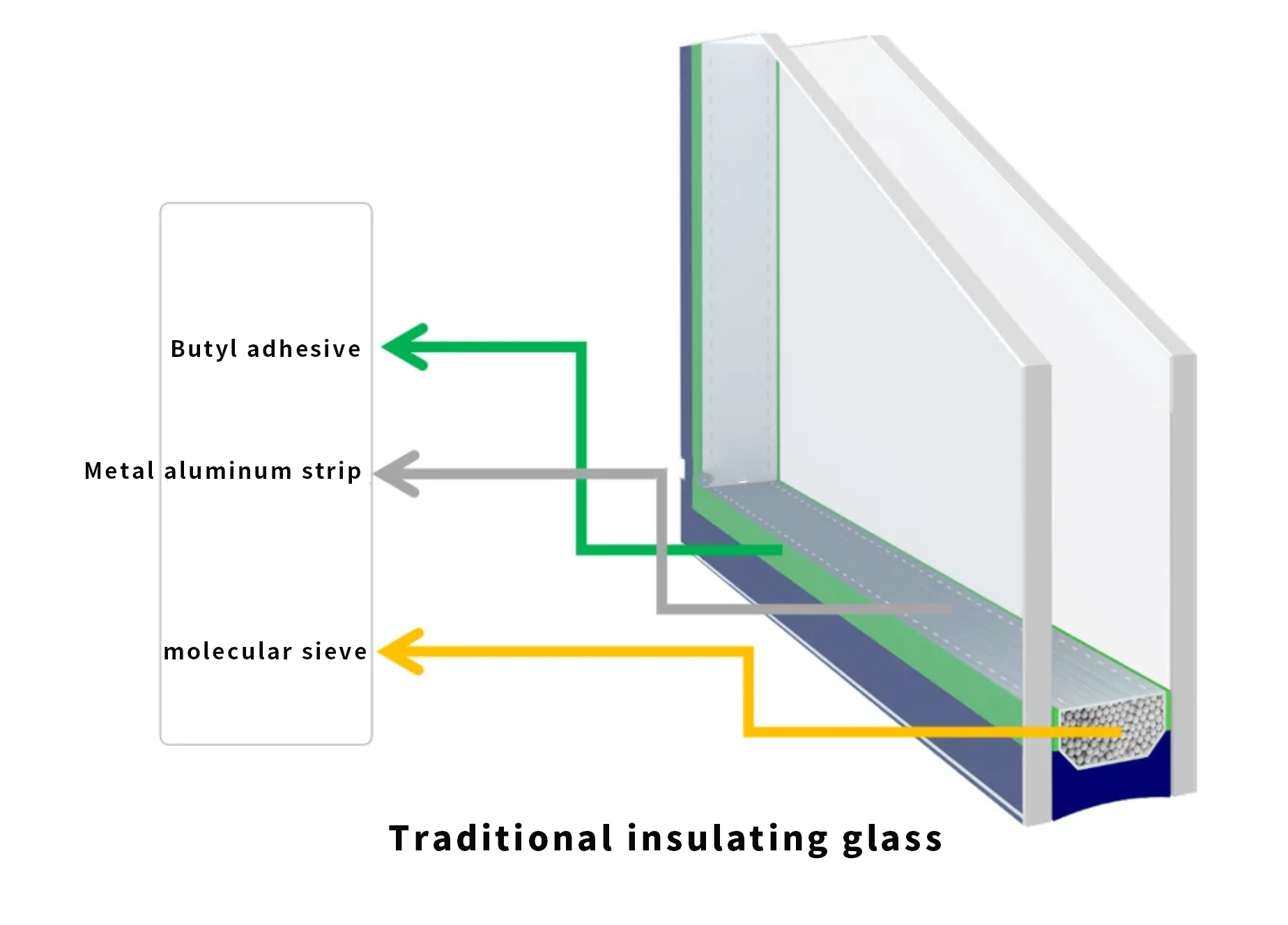
The processing of insulating glass has undergone five historical stages, being with the initial blowing, welding, and single sealing, progressing to the double sealing that is currently in use, and finally culminating in the advent of TPS sealing. Currently, the most prevalent method is double-layer adhesive sealing, which involves the application of a butyl adhesive sealant and a polysulfide adhesive or silicone sealant.
The most prevalent aluminum bar currently available on the market is silver. High-grade windows are sprayed black fluorocarbon aluminum bar for aesthetic purposes. Aluminum bar processing can be divided into one-piece bending and insertion of two types. One-piece bending aluminum has a single interface per circle, whereas insertion processing aluminum has four interfaces, located in the four corners of the glass. The aluminum hollow cavity is filled with 3A molecular sieve (also know as desiccant), which serves to absorb the water vapor in the glass hollow cavity. The molecular sieves occupy approximately 90% of the aluminum bar's cavity. The molecular sieves occupy approximately 90% of the aluminum bar's cavity. If the quantity of molecular sieve is insufficient, the sieve will become saturated at an accelerated rate. This is because the sieve absorbs water vapor, which produces a certain amount of heat. However, the expansion of the sieve aslo occurs, which prevents it from completely filling the cavity in the middle of the aluminum bar. Consequently, the desired level of saturation, which is approximately 90%, cannot be achieved.
Some manufacturers frequently utilize double-sided adhesive in lieu of butul rubber due to its comparatively low cost. The use of double-sided adhesive sealing is associated with significant shortcomings. The glass is prone to leakage and fogging over an extended period. The second layer of sealant sealing is also of paramount importance. Some manufacturers may resort to the use of inferior sealant in order to reduce production costs.
The aluminum partition strip situated in the center of the glass can be subtituted with conventional warm-edge strips, thereby conferring a marginal improvement in thermal insulation. To acheive a more pronounced enhancement in thermal insulation, it is possible to select TPS super warm-edge strips.