Aluminum profiles are prized for their heat resistance, corrosion protection, durability, and lightweight strength, making them ideal for Africa's demanding environments—from intense sunlight to coastal humidity. Custom aluminum profiles can meet diverse architectural designs and aesthetic requirements.Moreover, aluminum is fully recyclable, making it a key material for modern green buildings and a preferred choice among African builders and architects.However, when pursuing green-certified buildings, how can you enhance living comfort and reduce energy costs without compromising thermal insulation? The answer lies in extruded aluminum profiles paired with polyamide thermal break strips (PA66) and EPDM sealing gaskets.
Understanding the manufacturing process and thermal insulation principles of thermal break aluminum profiles allows you to easily customize the right aluminum extrusion for your ideal building solution.
Aluminum extrusion is a manufacturing process where an aluminum billet is heated and forced through a precision die to achieve the desired cross-sectional shape. The extruded profile is then cooled, stretched, and surface-treated to meet dimensional, strength, and appearance requirements.
Thermal break aluminum profiles, also known as thermal insulation aluminum profiles, are an upgraded version of standard extruded aluminum with an added thermal break design. During production, no harmful substances are generated, and all materials are fully recyclable—making them eco-friendly green building materials aligned with sustainable development. Compared with ordinary aluminum profiles, thermal break aluminum offers superior thermal insulation, sound insulation, and fire resistance, making it an ideal material for green, sustainable, and energy-efficient buildings.
Production Flow Chart: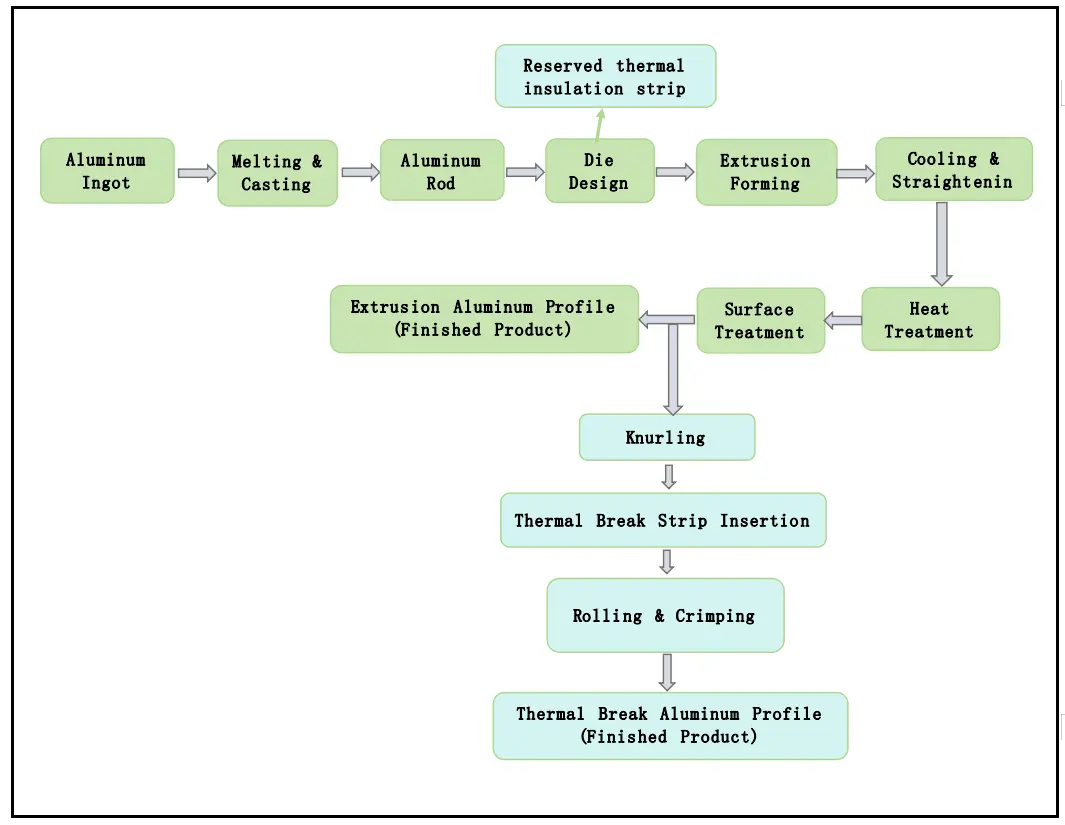
The production processes are largely similar, with four key differences:
 Windows and doors made with thermal break aluminum profiles significantly reduce heat transfer, maintain balanced indoor and outdoor temperatures, and markedly improve building energy efficiency. Compared with ordinary aluminum windows and doors, thermal break aluminum systems can reduce energy loss by approximately 30%.
By perfectly combining high-strength, high-rigidity glass fiber with PA66 nylon, which has a high melting point, excellent heat resistance and self-extinguishing properties, the PA66GF25 thermal break strips is highly matched with aluminum alloy profiles in terms of performance. It has synchronous expansion and contraction when the temperature changes, tight bonding and not easy to crack, and has excellent characteristics such as heat insulation, high strength and aging resistance.
Internationally standardized PA66 thermal break strips are PA66GF25 composite material with strictly defined composition:
| Component | Content Requirement | Description |
| Polyamide 66 (PA66, commonly known as Nylon 66) |
≥65% (optimal: 65%–72.5%) | Base material providing heat resistance and strength |
| Glass Fiber (GF) | 25% ± 2.5% | Reinforcement material enhancing rigidity |
| Processing Additives | ~10% | Improving processing performance |
| Comparison Dimension | PA66 Thermal Break Strip (PA66GF25) | PVC Thermal Break Strip |
| Tensile Strength | >120 MPa, high strength, structurally stable | ~50–80 MPa, low strength, prone to deformation, posing safety risks |
| Heat Deflection Temperature | ~240°C, high temperature resistant, not easily deformed | ~90°C, softens and deforms under high temperatures |
| Linear Expansion Coefficient | Almost identical to aluminum alloy; synchronous expansion and contraction during temperature changes, tight bonding without cracking |
Significantly different from aluminum alloy; thermal cycling easily causes cracking at joints, affecting sealing and structural safety |
| Aging Resistance | Durable, resistant to aging and brittle cracking; service life reaching decades |
Sensitive to light and heat, prone to aging and brittleness; short lifespan, typically showing problems within a few years |
| Flame Retardancy | Self-extinguishing when removed from flame, good flame retardancy; may produce slight yellow flame and odor similar to burnt hair when burning |
Flammable when exposed to fire, continues burning after removal; blue flame with pungent plastic odor |
| Environmental Friendliness | Recyclable and reusable | Causes environmental pollution during incineration or disposal |
| Color | Matte frosted black, uniform color, fine matte texture on surface | Usually glossy black, very smooth surface, sometimes with whitish discoloration |
| Flexibility | Highly flexible, difficult to break; bends under force without snapping, clean break surface without deformation |
Poor flexibility, brittle; breaks after 1–2 bends, whitish and deformed break surface |
Reputable manufacturers not only avoid inferior thermal break strips but also conduct the following tests to ensure product quality:
Both standard and thermal break aluminum profiles offer corrosion resistance, durability, light weight, and high strength. As a more energy-efficient green building material, thermal break aluminum profiles provide the following outstanding advantages:
Thermal insulated aluminum profiles utilize PA66 thermal break strips to block heat conduction, significantly reducing the overall heat transfer coefficient. The thermal conductivity of PA66 is 0.3 W/(m·K), while that of non-thermal break aluminum can reach 200~235 W/(m·K). PA66's thermal insulation performance is approximately 600~800 times that of ordinary aluminum, effectively blocking heat transfer.The U-value of non-thermal break windows is 4.0~7.0 W/m²K, while the U-value of thermally insulated aluminum profile windows can be reduced to 1.2~2.5 W/m²K, providing an energy-efficient and comfortable environment for buildings.
In summer, standard aluminum profiles continuously conduct outdoor heat indoors due to the thermal bridge effect, causing air conditioning to run constantly and energy consumption to remain high. With thermal break aluminum systems:
Standard aluminum profiles conduct heat too quickly, causing outdoor temperature changes to rapidly transfer to the indoor side, leading to condensation on the inner frame—especially noticeable in high-humidity coastal areas. The thermal break aluminum structure keeps the indoor-side frame temperature closer to room temperature, greatly reducing condensation risk and effectively protecting interior finishes.
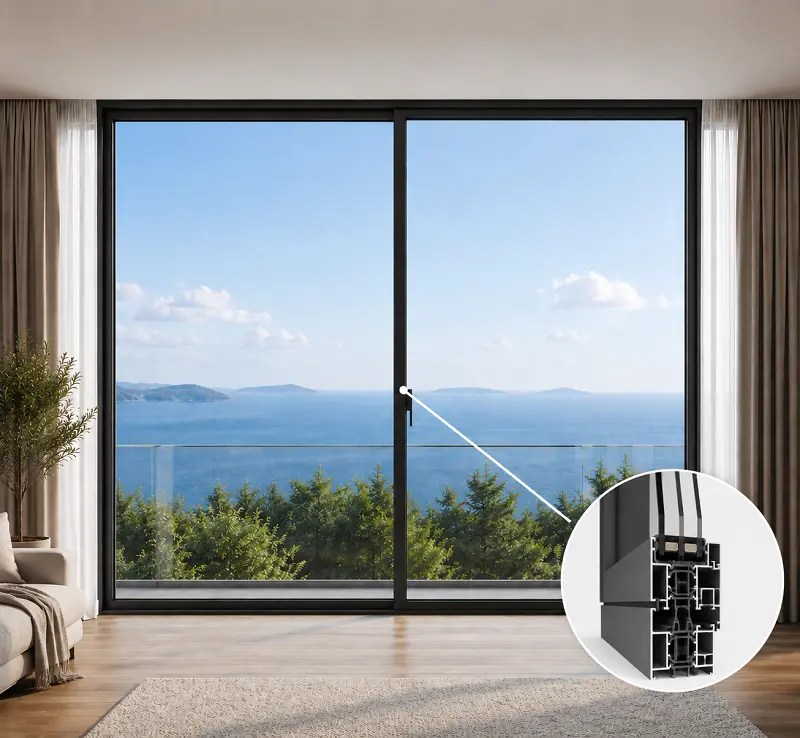
By eliminating thermal bridges, thermal break aluminum windows and doors can:
Standard aluminum profiles and thermal break aluminum profiles are complementary choices, each suited to specific applications:
Africa's hot climate, rapid urbanization, and current regulations mandating energy-efficient windows for commercial buildings have raised the bar for material value and performance among builders and architects. Thermal break aluminum windows and doors deliver outstanding thermal insulation, sound insulation, and energy efficiency in extreme climates, making them the preferred solution for modern energy-efficient building projects in Africa.
If you are looking for a trusted aluminum extrusion supplier and professional customer service, we welcome you to contact us. We are ready to provide customized aluminum extrusion solutions and responsive customer support for your next project.
